Within the framework of interdisciplinary projects and collaborations, ALMA has recently been very intensively researching Late-Gothic paintings in Central and Eastern Europe, especially those whose origin was related to activities of German-speaking communities - whether in the Czech Republic (Ore mountains/Erzgebirge region), Slovakia (Spiš/Zips region) or Romania (Transylvania/ Siebenbürgen). A special attention was paid to the works of Master Paul from Levoča/Leutschau, which is considered to be one of leading persons of the late Gothic art in Central Europe.
In early 16th century the wealth of the Spiš region originated mainly from the flourishing mining industry; in the workshop of Master Paul it was predominantly manifested by the richness of gilding and silvering employing various techniques and metal foils. Silver or Zwischgold surfaces were usually covered by red, green and yellow glazes, which are only rarely preserved and their remnants were often removed by previous restoration treatments. Other employed materials evince signs of the period as well as regional features. A characteristic related to the period is the usage of bauxite instead of red clay for poliments. On the other hand, regional specifics represent the admixture of kaolin in the chalk ground – an experimental material imported from the Tokaj hills, probably in relation with the wine trade.
Recent publications:
Hradilová J. Hradil D.: Technologická specifika Mistra Pavla a jeho dílny (Technological Specifics of Master Paul and his Workshop). In.: Novotná, M. (Ed.): Majster Pavol z Levoče a jeho doba, Slovak National Museum – Spiš Museum Levoča, 2018, 113-121
Hradilová J., Hradil D.: Malířské materiály a technika Majstra Pavla z Levoče na základě studia vybraných děl. In.: Novotná M., Piatrová A. (Eds.) Majster Pavol z Levoče: Ruky a zlato v službe ducha. SNM – Historické muzeum Bratislava, 2017, 63-73.
Hradil D., Hradilová J., Bezdička P., Serendan C.: Late Gothic / Early Renaissance gilding technology and the traditional poliment material "Armenian bole": truly red clay, or rather bauxite? Applied Clay Science 135 (2017), 271-281. https://doi.org/10.1016/j.clay.2016.10.004
Hradil D., Hradilová J., Bezdička P., Matulková I.: Kaolinite-alunite association in Late Gothic white grounds from Slovakia: a local peculiarity in painting technology. Applied Clay Science 177 (2017), 79-87. https://doi.org/10.1016/j.clay.2017.05.004
Invited article:
Hradil D., Hradilová J., Bezdička P., Razum I.: Pre-industrial Use of Bauxite by Late Gothic Goldsmith Masters: Analytical Evidence and Experimental Study. Chem plus Chem 2025, e202500044. https://doi.org/10.1002/cplu.202500044
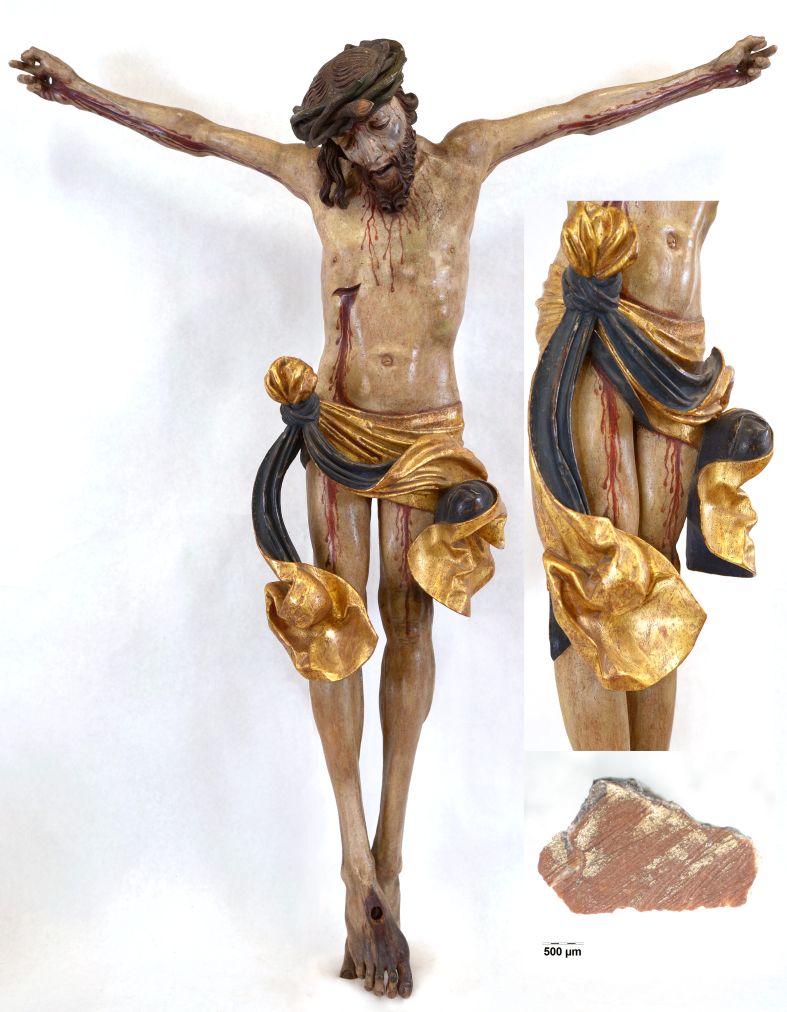
Polychrome statue of Christ crucified from Spišské Vlachy, Slovakia, dated around 1520, attributed to Master Pavol of Levoča (photo by Š. Siváň), with a gilded veil, from which a fragment of gilding was removed, revealing clearly visible red poliment containing Al-rich bauxite (bottom right).