In Europe, portrait miniatures first appeared in England in the 16th century – painted on stretched parchment or paper. The way of their preparation was inspired by mediaeval illuminated manuscripts. After 1700, ivory plates were introduced and became the most frequent support of the 18th and 19th centuries. Watercolour and gouache were the most common techniques, but there may be other ones. Due to variability in the employed materials, it is not easy to find a uniform analytical procedure.
Since it is not possible to take any samples for materials research – due to the very thin, detailed and highly compact painting – a fully non-invasive multi-analytical approach has been introduced in ALMA. It combines large area scanning techniques (particularly MA-XRF), portable spectroscopic methods, and laboratory methods adopted for measuring small objects in ambient atmospheric conditions (XRPD, environmental SEM). This analytical strategy brought a number of surprising results - copies and forgeries were distinguished, the originality or secondary modification of signatures was proved, retouches and over-paintings were located, highly specific pigments were identified (e.g. Purple of Cassius). For the first time ever, the processes of saponification have been evidenced in miniature portraits.
Recent publications:
Garrappa, S., Bezdička, P., Švarcová, S., Hradilová, J., Pech, M., & Hradil, D.: Non-invasive evidence of mercury soaps in painted miniatures on ivory. The European Physical Journal Plus, 138(3) (2023), 219. https://doi.org/10.1140/epjp/s13360-023-03847-z
Širillová Z, Hradilová J., Pech M., Švarcová S., Bezdička P., Neděla N., Hradil D.: Gold nanoparticles in painted miniatures on ivory: Non-invasive evidence and characterisation. Dyes and Pigments 210 (2023), 111015. https://doi.org/10.1016/j.dyepig.2022.111015
Hradil D., Hradilová J., Sondej A.: The Benefits of Macro X-ray Fluorescence Scanning for the Analysis of Materials in Portrait Miniatures. In Pappe B., Schmieglitz-Otten J. (Eds.): Portrait Miniatures – Artists, Functions, Techniques, Collections. The Tansey Miniatures Foundation, Celle & Michael Imhof Verlag, 2023, Germany, ISBN 978-3-7319-1339-9
Hradilová J., Hradil D., Sondej A., Trmalová O.: Vzestupy a pády portrétní miniatury / katalog k výstavě, Akademie výtvarných umění v Praze, Praha 2022, ISBN 978-80-88366-44-7
Hradil D., Hradilová J., Sondej A., Trmalová O.: Kopie a falzifikáty v portrétní miniatuře / katalog k výstavě, Ústav anorganické chemie AV ČR, Praha 2022, ISBN 978-80-904678-5-9
Garrappa, S., Hradil, D., Hradilová, J., Kočí, E., Pech, M., Bezdička, P., & Švarcová, S.: Non-invasive identification of lead soaps in painted miniatures. Analytical and Bioanalytical Chemistry, 413(1) (2021), 263-278. https://doi.org/10.1007/s00216-020-02998-7
Hradilová J., Hradil D., Pech M., Bezdička P., Neděla V., Tihlaříková E., Targowski P.: Complementary use of X-ray based imaging and analytical methods in the investigation of miniature portraits. Microchemical Journal 153 (2020) 104371, https://doi.org/10.1016/j.microc.2019.104371
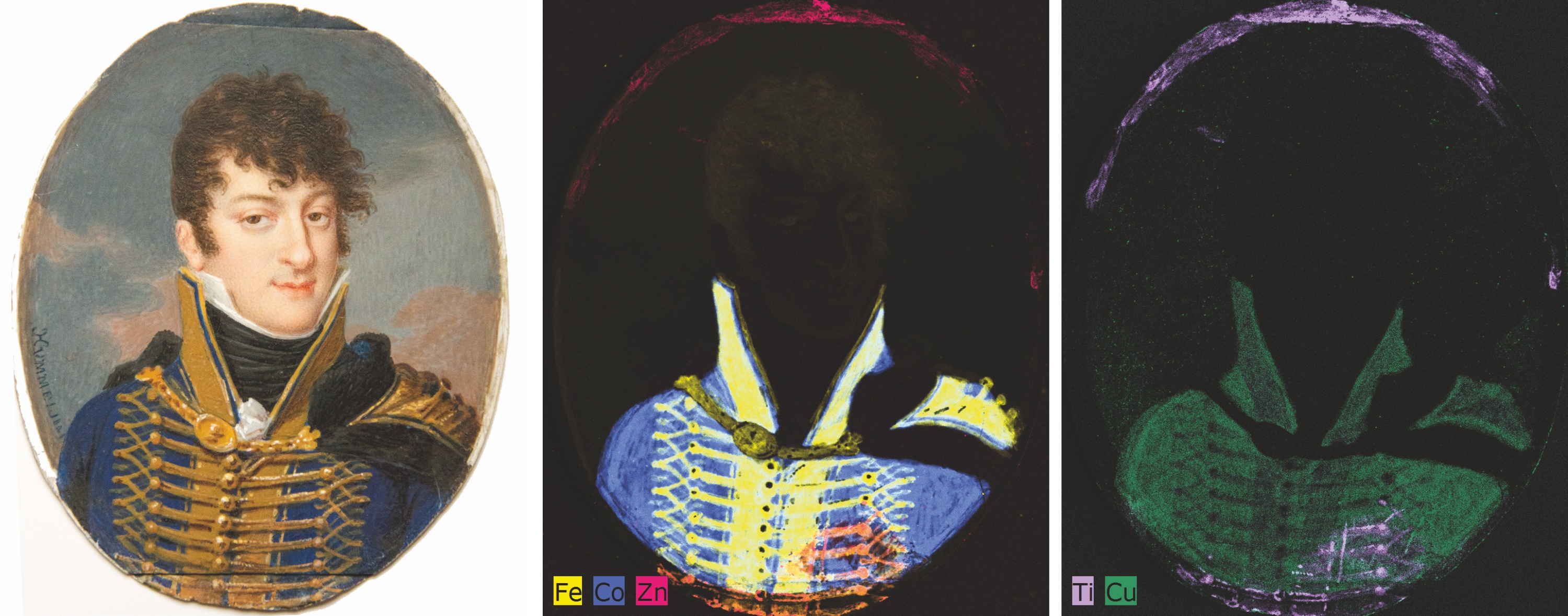 Example of a miniature from the Chomutov Regional Museum – maps of selected elements showing areas with Zn and Ti white retouching; the blue uniform is painted with a mixture of Co and Cu-based pigments.